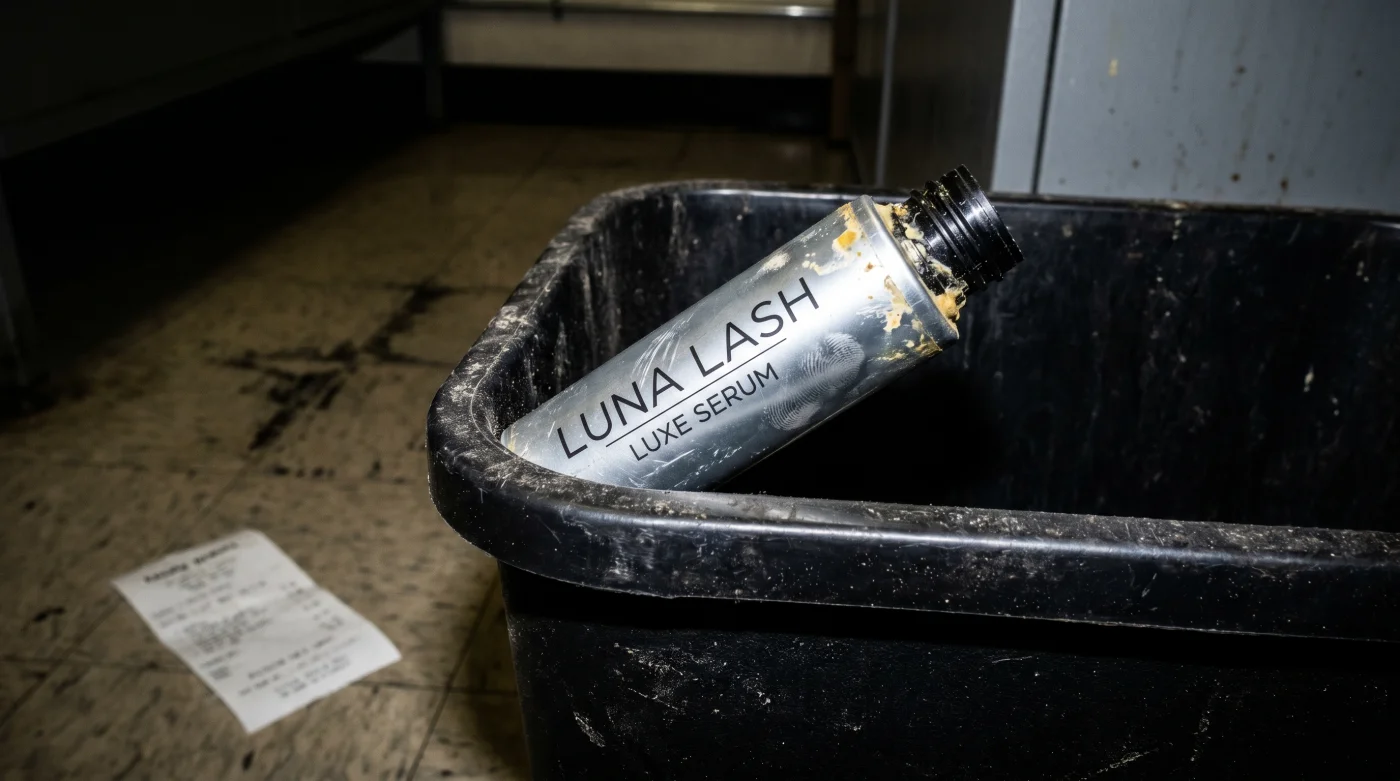
The bathroom mirror is slightly fogged from the hot tap, and the house is finally quiet. The distinct smell of lavender bath oil lingers in the air. You unscrew a tiny, silver tube, feeling the cool click of the cap before carefully dragging the finest of brushes along your upper lash line. It is a mundane, hopeful little ritual, one you perform with the precision of a watchmaker, promising a fluttery, wide-awake gaze by the time Monday morning rolls around.
We have grown accustomed to trusting these small bedtime routines. If a product sits on the brightly lit shelves of a High Street chemist, nestled comfortably between harmless micellar waters and gentle moisturisers, we assume a strict, invisible safety net has guaranteed its absolute harmlessness. You apply the serum, trusting the regulatory system to have done the heavy lifting for you.
But a profound correction is currently rippling through the British beauty industry, hidden behind vague out-of-stock notifications and softly reformulated ingredient lists. Retailers are quietly pulling some of the most famous, bestselling lash serums from their physical and digital shelves. It is not a supply chain hiccup; it is a delayed reckoning with a potent chemical truth.
The ingredient under sudden, severe scrutiny is the prostaglandin analogue. Originally formulated as a medical drop to reduce pressure in glaucoma patients, its famous side-effect—rapid, undeniable lash growth—birthed a lucrative cosmetic loophole. Now, a major safety review has confirmed what ophthalmic experts have whispered for years: these compounds are directly linked to irreversible orbital fat loss.
The ‘Sinking’ Truth About Miracle Growth
To understand what is happening, you must stop viewing your eye area as a simple canvas for makeup. Think of your eyelid and the surrounding tissue as a delicate silk hammock, plumped and supported by a very specific, microscopic cushion of fat. This cushion is what gives the eye a youthful, rested, and structurally sound appearance.
When you paint a prostaglandin analogue along the lash root, you aren’t just feeding a hair follicle. You are applying a potent synthetic lipid compound that slowly dissolves that supporting fat cushion. The serum seeps beneath the skin barrier, signalling the fat cells in the periorbital area to shrink and atrophy. The lashes grow incredibly long, yes, but the eye itself sinks backwards into the skull, creating hollow, darkened tear troughs that no concealer can fix.
Dr Eleanor Vance, a consultant oculoplastic surgeon based in London, has watched this specific casualty unfold over the past three years from her Harley Street clinic. She began noticing women in their late twenties arriving with the sunken, shadowed eye sockets typically seen in patients two decades older. They were exhausted, confused, and heavily reliant on thick colour-correctors. “They would sit in my chair asking for expensive tear-trough filler,” she noted in a recent ophthalmic safety briefing. “But the moment I saw the hyper-pigmented lash line—a classic tell-tale purple hue—and the sudden atrophy of the fat pads, I knew exactly what had happened. The culprit was sitting in their makeup bags. They were unknowingly trading their facial volume for a few millimetres of hair.”
Reading The Fine Print Of Your Routine
The danger lies in how easily these medical-grade compounds were slipped into everyday cosmetics. Because they are technically categorised as conditioning agents in the UK rather than medicines, they bypassed the rigorous long-term trials required for pharmaceuticals. To protect the architecture of your face, you need to audit your bathroom cabinet immediately.
- Women Over 40 Are Applying Hyaluronic Acid Backwards (And It Ruins Their Skin Barrier)
- Taking Collagen Peptides Without This Morning Drink Wastes Your Money Completely
- The 3-Minute Morning Jawline Technique That Replaces Expensive Dermal Fillers
- Dermatologists Beg Women To Stop Mixing Retinol Cream With This Common Night Oil
- The ‘Triangle’ Concealer Trick Actually Accentuates Fine Lines After 50
- The £2 Supermarket Staple That Removes Product Build-Up Better Than Luxury Shampoos
- Leaving Micellar Water On Your Face Is Slowly Destroying Your Moisture Barrier
For the Unwitting User
If your serum works miraculously well, producing spider-leg length in a matter of weeks, it likely contains a prostaglandin analogue. Turn the tube over and look for the chemical markers. You are searching for complicated names like Isopropyl cloprostenate, Dechloro Dihydroxy Difluoro Ethylcloprostenolamide, or anything ending in ‘prost’. If it is there, you are actively thinning the fat around your eyes.
For the Hydration Purist
If you want to maintain healthy lashes without the structural risk, you must pivot entirely to peptide-based formulas. These work like a protein shake for the hair shaft rather than a hormonal override. They will not give you the freakish length of a prostaglandin, but they will strengthen the hair shaft while leaving your orbital fat entirely alone.
For the Recovering Eyelid
If you have been using these serums for years and notice a sudden hollowing out of your upper eyelid, stop application tonight. While the fat loss is frequently described as irreversible in clinical literature, ceasing the chemical exposure immediately stops the degradation. The surrounding skin barrier can then be babied back to health with ceramides and gentle hydration.
The Safe Lash Protocol
Shifting away from synthetic hormones does not mean abandoning your evening self-care. It simply requires a gentler, more anatomically respectful approach to conditioning. By focusing on the structural health of the hair rather than forcing an unnatural growth cycle, you protect your facial architecture.
The protocol is simple, requiring only a few deliberate movements before sleep.
- The Warm Compress: Before applying any serum, press a warm, damp flannel over closed eyes for sixty seconds to soften the lash root.
- The Peptide Swap: Coat the lashes lightly with a pure peptide and panthenol blend, avoiding the skin of the eyelid entirely.
- The Mid-Shaft Application: Paint the conditioning serum from the middle of the lash to the tip, rather than scrubbing it into the delicate baseline root.
- The Castor Oil Seal: Once a week, use a spoolie to brush cold-pressed castor oil through the lashes to lock in moisture and prevent snap-breakage.
The Tactical Toolkit
To execute this safely, keep your peptide serum at room temperature, ideally around eighteen degrees Celsius. Cold temperatures can cause the thickeners in peptide serums to clump, pulling on the lashes during application. Replace your applicator spoolie every three months to prevent bacterial micro-infections that cause premature lash shedding.
Reclaiming The Mirror
The quiet removal of these serums from High Street shelves is a rare moment of the cosmetic industry correcting itself before a silent problem becomes a loud public health epidemic. It forces us to ask a rather uncomfortable question about our daily routines: at what point does the pursuit of a singular aesthetic detail compromise the whole? We have been sold the idea that more is always better—more length, more volume, faster results—without questioning the biological toll of that speed.
True authority over your appearance does not come from applying the most potent chemical you can find. It comes from understanding the delicate ecosystem of your own face. When you throw away the silver tube and choose a gentler path, you aren’t sacrificing your beauty; you are protecting your future face. You are learning to read the labels, respect the fat pads that give you youth, and finally sleep soundly, knowing your evening ritual is genuinely caring for you.
“True cosmetic elegance is found in formulations that respect the anatomy, rather than those that wage war on it for a temporary aesthetic gain.” – Dr Eleanor Vance
| Key Point | Detail | Added Value for the Reader |
|---|---|---|
| Growth Mechanism | Prostaglandins force the anagen phase; Peptides reinforce the hair shaft. | Understand why one causes unnatural length while the other prevents daily breakage. |
| Structural Risk | Analogues are linked to periorbital fat atrophy and hyperpigmentation. | Identify the root cause of sudden dark circles and hollowed eyelids in your twenties. |
| Ingredient Markers | Look for ‘Isopropyl cloprostenate’ or suffix ‘-prost’. | Equips you to scan INCI lists on the High Street and avoid hidden synthetic lipids. |
Frequently Asked Questions
Can the orbital fat grow back if I stop using the serum?
Unfortunately, periorbital fat atrophy is largely considered permanent. However, stopping the serum immediately prevents further hollowing and allows the skin moisture barrier to recover, which can slightly improve the sunken appearance.Are all lash serums on the High Street dangerous?
No. The safety alert specifically targets serums containing prostaglandin analogues. Many excellent, safe serums rely entirely on amino acids, peptides, and botanical conditioners like castor oil.Why were these allowed to be sold in the UK in the first place?
Cosmetic regulations often lag behind long-term clinical data. Because they were marketed as conditioners rather than medical glaucoma treatments, they bypassed the strictest pharmaceutical safety nets.Will a peptide serum give me the same dramatic length?
Peptides will not override your natural growth cycle to create unnatural length. They work by preventing premature shedding and thickening the hair you naturally have, resulting in a healthier, fuller fringe over time.What should I do with my current prostaglandin serum?
If it contains the analogue markers on the ingredient list, the safest medical advice is to dispose of it immediately. The cosmetic payoff simply isn’t worth the structural damage to your eye area.